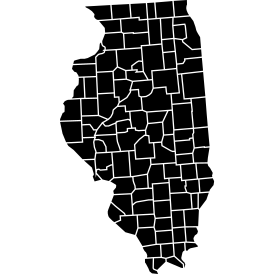
Illinois Property Records
In Illinois, property records are public documents and provide essential details such as the names of property owners, legal parcel descriptions, property tax obligations, sales prices, and dates of transfer. They may also reflect subdivision information and historical ownership data, which allows users to track how land has changed over time.
Illinois is divided into 102 counties, each with a designated county recorder responsible for recording and indexing official documents for public access. These local offices serve as the main point of contact for residents, businesses, and legal professionals seeking property information.
Real estate records in Illinois are widely used for practical and legal purposes. Individuals rely on them to confirm ownership before sales, researchers examine them to study land history, attorneys use them in resolving disputes, and local governments review them for planning and development projects.
Introduction to Property Records
Illinois property record-keeping dates back to the early 1800s, when counties first began documenting land transfers and ownership. The Illinois General Assembly established the office of the county recorder in 1819, assigning it the duty of filing deeds and maintaining chronological entry books for public reference.
The state follows a deed recording system rather than a Torrens title registration approach. Property records are maintained at the county level, with larger counties employing a county recorder and smaller ones assigning the function to the county clerk.
Over time, many counties have adopted digital systems to improve accessibility. For instance, Sangamon County offers online access to deed images dating back to 1901 and accepts electronic recording submissions.
The Illinois Department of Revenue notes that the county assessor’s office oversees property tax administration, using recorded deeds and transfers to determine values. Property taxes are a vital revenue source for municipalities and counties. They are collected locally and distributed to taxing districts levying them, with schools receiving the largest share.
Beyond taxation, property records support development and planning. Planners, surveyors, assessors, and environmental agencies use parcel descriptions and ownership histories to guide zoning, infrastructure projects, and community development across Illinois.
What Counts as Property Records in Illinois
Illinois property records consist of official documents detailing ownership, transfers, and legal claims over land or buildings. The main types of records available include:
Deeds & Title Records
Deeds and title records document the legal transfer of real property, showing grantor, grantee, and property description. The Illinois Secretary of State mentioned that each county recorder maintains all real estate deeds submitted for recording, with thousands of new deeds filed annually across the state.
Ownership History & Transfers
Ownership and transfer records trace changes in property ownership and conveyance history. Illinois law requires a Real Estate Transfer Declaration Form (PTAX-203) with every deed unless exempted, providing sales data used in state ratio studies. Each year, hundreds of thousands of transfers occur across the state, which trigger updates in county land records.
Mortgage & Loan Documents
Mortgage and loan documents in Illinois record liens and deeds of trust filed in county recorder offices to secure property debt. The Illinois Housing Development Authority reported more than 9,200 first mortgage applications statewide in FY 2023, totaling $1.6 billion in home loans. Many borrowers also received forgivable assistance through IHDA’s Access 4% program.
Property Tax Records & Assessments
Illinois property tax records encompass assessed values, tax bills, exemptions, and payment histories, all managed by local assessors and collectors. Most properties are assessed at 33⅓ % of fair market value, except in Cook County, which employs a classification system for assessment.
Additionally, Illinois offers several exemptions for residential properties, including the General Homestead Exemption, which reduces the equalized assessed value of a primary residence, and the Senior Citizens Homestead Exemption, available to homeowners aged 65 or older.
Property Values & Market Data
These records show property sales, market performance, and assessed valuation trends. Recent data shows that the average home value in Illinois is approximately $284,000. This reflects steady appreciation and continued statewide growth driven by limited housing supply and consistent buyer demand in major metropolitan areas.
Building Permits & Zoning Records
Building permits and zoning records document construction, land use, and code compliance. According to recent U.S. Census Bureau data, Illinois issued thousands of new private housing permits yearly, with statewide construction permits declining about 1.65%.
Liens, Foreclosures & Judgments
In Illinois, liens, foreclosures, and judgments are legal records affecting property ownership and property rights. In 2024, new residential foreclosure filings increased by 2.7% compared to 2023. Meanwhile, as of 2025, monthly foreclosure filings average about 575, down from 824 in the previous period.
Parcel Maps & Land Surveys
Parcel maps and land surveys in Illinois define property boundaries and ownership, and counties maintain and update this data through the Geographic Information System.
Illinois Property Law
Illinois property law functions through statutes compiled in the Illinois Compiled Statutes (ILCS), establishing regulations for land ownership, transfers, and usage across the state. Chapter 765 of ILCS contains the property code, which serves as the central source defining rights, responsibilities, and procedures for real estate matters affecting property owners in the state.
Key Statutory Framework
The statutory framework represents the collection of codified laws forming the legal basis for property rights and transactions. Foundational provisions appear in 765 ILCS 1005/, the Joint Tenancy Act, addressing co-ownership arrangements between parties.
Building upon this foundation, other statutes under Title 765 ILCS address more specific matters. Common law doctrines supplement these legislative provisions where explicit statutory guidance is absent, which forms a hybrid system of regulation.
Deeds and Conveyances
A deed is a legal document that transfers real estate ownership from one party to another. Under 765 ILCS 5/, the Conveyances Act, it must be properly executed, delivered, accepted, and recorded.
Moreover, the Act establishes a race-notice system under Sections 5/28 through 5/30, which gives priority to purchasers who record their deeds first and have no prior knowledge of earlier unrecorded claims.
Mortgages and Liens
A mortgage creates a security interest in realty to secure the repayment of a debt, while a lien establishes a creditor's claim against the property for unpaid obligations. Illinois addresses mortgage foreclosures through 735 ILCS 5/Article XV, the Illinois Mortgage Foreclosure Law, which establishes judicial foreclosure procedures, redemption rights, and borrower protections.
In addition to mortgage regulation, Illinois law provides mechanisms for other property-related claims. As stipulated in the Mechanics Lien Act found in 770 ILCS 60/, contractors and suppliers may secure payment through property liens, while federal tax liens are governed under the Uniform Federal Lien Registration Act in 770 ILCS 110/.
Easements
An easement allows limited use of another’s land without transferring ownership and may be created through written grants, implied conditions, or long-term use.
In Illinois, subdivision-related easements follow the Plat Act under 765 ILCS 205/, which governs their creation and recording, while property boundaries and easement markers are regulated under the Land Survey Monuments Act within 765 ILCS 220/.
Over time, easements may come to an end through abandonment, the merger of the benefiting and burdened properties, or an express release by the holder
Zoning Regulations
Zoning regulations comprise governmental restrictions determining permissible land uses within specified territorial boundaries. Municipalities derive zoning authority from 65 ILCS 5/Article 11 Division 13 of the Illinois Municipal Code. It empowers cities to create districts, regulate building heights, and control density.
Counties exercise similar powers over unincorporated areas through 55 ILCS 5/Division 5-12. Property owners challenging zoning decisions seek relief through administrative review proceedings under 735 ILCS 5/Article III.
Public Records Law
Illinois public records law governs how property-related documents are recorded, preserved, and accessed. Under 55 ILCS 5/Division 3-5, county recorders maintain indexed records of deeds, mortgages, liens, and similar instruments that establish ownership and serve as public notice for future buyers and creditors.
To further improve efficiency, the 765 ILCS 33/ Uniform Real Property Electronic Recording Act enables counties to accept and process these filings electronically, updating traditional paper systems while maintaining document authenticity and reliability.
Meanwhile, under 5 ILCS 140/, the Freedom of Information Act, citizens and title companies may access recorded property information through lawful public inspection.
The Role of Government Agencies
In Illinois, county recorder offices manage property records as specified in the Illinois County Code. In smaller counties, the county clerk may also perform recorder duties when both offices are combined. Alongside the recorder, the county assessor’s office and county treasurer’s office perform key roles in property valuation and taxation.
The assessor determines property values for taxation using recorder data, building permits, and local property updates, while the treasurer collects property taxes, manages billing and payments, distributes revenues to local government entities, and works closely with the assessor to maintain accurate tax records.
At the state level, the Illinois Department of Revenue complements these functions through the Real Estate Transfer Declaration, which documents property transfers and assists in verifying transaction details.
Meanwhile, municipal planning, zoning, and building departments handle records related to land use, permits, and development, but not property titles. Courts may refer to recorded documents when settling ownership disputes, while title registration remains a core county function.
How to Access Property Records
Access to recorded property documents in Illinois depends on the county, with several available methods for obtaining them. The main ways are:
Online: Property details can be reviewed through county search portals. For example, the Cook County Clerk’s Property Search Portal lets you locate deeds, mortgages, and other recorded instruments filed under your property.
In Person: Visiting your county clerk and recorder’s office allows direct access to certified copies of deeds or land records. Offices such as Jackson County Clerk & Recorder and Knox County Recorder accept in-person record requests.
By Mail: You may send a written request to your county recorder or clerk’s office, including the correct form and payment for copy fees. Each county website lists mailing addresses, instructions, and processing times for document requests.
By Phone: You can call the county recorder or clerk’s office to check record availability, required fees, or request procedures. For example, the Jackson County Clerk & Recorder may be reached at (618) 687-7360.
Limitations of Accessing Property Records
Anyone can access Illinois real property records, but locating specific information can be challenging since each county follows its own rules, costs, and procedures. These include:
Decentralized Record System: Each county recorder maintains its own system, so search procedures, data formats, and fees differ across Illinois. This makes statewide research difficult and time-consuming.
Different Access Fees: Some counties provide free online searches, while others charge for document copies or certification. Costs depend on local policies under 55 ILCS 5/3-5018.2 and may also vary based on local ordinances adopted by each county.
Limited Online Availability: Not all counties have digitized their property files. Smaller or rural offices may require in-person visits or mailed requests to obtain older records.
Difficulty Knowing Where to Search: Property-related data may be split between the recorder, assessor, treasurer, or circuit clerk. Finding the right office often requires knowing what specific record is needed.
Varied Access Methods: Depending on the county, you may be able to search records online, visit in person, call for assistance, or send a written request by mail.
Privacy and Redaction Rules: Certain personal identifiers, such as Social Security Numbers, are redacted under the Illinois Freedom of Information Act. This may limit the completeness of available documents.
How Property Records Are Updated
Major updates to property details lead to the revision of real estate documents. The responsibility for processing these revisions lies with various government offices, and the period for updating records depends on the kind of document involved:
Sales or Transfers of Property: Deeds in Illinois are recorded at the county recorder's office, are time-dated, and are placed on record in the order received. Most documents are recorded the day they are received, with originals returned on the following business day.
New Mortgage or Lien Filing: Mortgages and other instruments are filed with Illinois county recorders and time-dated in the order received. In practice, the availability of newly recorded documents may vary by county. For example, in Will County, recorded documents are generally accessible within approximately five days of filing.
Building Permits: Local Illinois municipalities issue building permits for construction projects, and these records are shared with county assessors to identify improvements. For instance, in Madison County, a copy of each permit must be forwarded to both the township and county assessors within 15 days after issuance.
Property Tax Assessments: Illinois law requires that all properties, except farmland, be inspected and reassessed every four years—or every three years in counties such as Cook County. In certain counties, the area is divided into assessment districts, with one district undergoing reassessment each year as part of a rotating schedule.
Court Judgments and Foreclosures: Court-ordered property transfers and foreclosure documents are recorded with county recorders after judicial proceedings. For example, in Edgar County, documents received after 3:00 p.m. are recorded on the next business day and are available shortly after processing.
The Importance of Property Records
Land records act as official public documents that confirm ownership rights, assist in property dealings, and make important information available to the following groups and individuals:
Property Buyers: Individuals purchasing real estate can access public records maintained by county recorders to research information before completing transactions. These records contain deeds, liens, and legal descriptions publicly available for review.
Property Sellers: They reference their recorded deeds, legal descriptions, and parcel data to confirm ownership details and support smooth transfer during property sales.
Mortgage Lenders and Financial Institutions: These entities benefit from recording their documents with Illinois county recorders. They file mortgages and liens as part of real estate financing transactions under Illinois law.
Title Companies and Law Firms: These professionals benefit by electronically recording their documents with Illinois county recorders. They work with recorded documents during real estate transactions and closings.
Government Officials: Illinois county personnel, including recorders and clerks, maintain and process these documents for public access. They also administer recording systems and manage document retrieval requests.
Researchers and Historians: They access archived property records to trace community growth, architectural development, and land use changes over time within Illinois counties.
What Information Do Illinois Property Records Contain?
Illinois property documents provide official information about land ownership, property taxation, and related legal matters. The type of information available may differ by county, but generally includes:
Ownership or Title Information: Lists the names of current and past owners, the legal description of the property, and the recorded transfer or sale dates.
Legal Description and Parcel Identification: Includes lot, block, subdivision, township, range, and the Property Index Number used for property assessment and tax purposes.
Assessment and Valuation Data: Shows assessed value, equalization factor, property classification, taxable value, and exemptions approved by the local assessor.
Tax and Payment History: Displays billed tax amounts, payments received, outstanding balances, and information about delinquent or forfeited taxes.
Maps, Plats, and Surveys: Provides property boundary maps, official plats of subdivision, and surveys that identify physical dimensions and land boundaries.
Legal Encumbrances and Restrictions: Lists easements, floodplain information, right-of-way notices, and other recorded limitations affecting property use.
Resolving Property Disputes
Various factors can lead to property disputes in Illinois. The most frequent concerns include:
Boundary and Survey Disputes (disagreements over property lines, encroaching structures, or conflicting survey markers)
Landlord-Tenant Conflicts (issues involving security deposits, lease violations, repairs, or unlawful retaliation)
Property Tax Assessment Disputes (challenges to property valuations believed to be inflated, inequitable, or inaccurate)
Adjoining Property Issues (conflicts over shared fences, excavations, or access to neighboring land for repairs)
Illinois offers several options for addressing property conflicts before turning to litigation. The process often begins with open communication, as many disputes are settled through direct discussion between the parties involved.
For issues related to property tax assessments, individuals may file the Non-Farm Property Assessment Complaint Form (PTAX-230) with their county board of review and, if the matter remains unresolved, elevate the appeal to the Illinois Property Tax Appeal Board.
Additionally, small claims court provides another avenue for disputes involving less than $10,000. It uses a straightforward process that requires little legal expertise. Individuals may begin by completing the Small Claims Complaint Form and filing it in the county where the dispute begins.
When boundaries are unclear, licensed surveyors can provide technical evaluations, while fence viewers assist in resolving disagreements between neighboring landowners. If these informal or local remedies fail, larger or more complex property disputes are brought before the circuit courts, where cases proceed under established civil procedures.
FAQs
Yes, many counties have online document search systems through their recorder or clerk offices. For instance, from March 16, 1961, to the present, DuPage County allows searches for recorded documents by name, address, or parcel.
You can look up Illinois property records by address or owner name using county property search tools, like Madison County’s Property Tax Inquiry, which lets you view ownership details, assessed values, and tax payment information.
Yes, county property records are public by default under the Illinois Freedom of Information Act. If an office refuses, you can appeal to the Illinois Public Access Counselor.
A property record card is the assessor’s file for a parcel, listing the land area, building details, and assessment history. You can obtain it from the county assessor’s office, as many make it viewable or printable through their website or upon request.
Many counties have digital deed records spanning several decades, while older records are kept on paper or microfilm at the recorder’s office. For the earliest transactions, you may need to visit in person.
Market value is the assessor’s estimate of what the property would sell for. Assessed value is a fraction of the market value used to calculate taxes, often about one-third in many Illinois counties.
You can find out if a property in Illinois has tax liens or unpaid taxes by visiting the county treasurer or using its online tool, such as McHenry County’s Property Tax Inquiry page.